
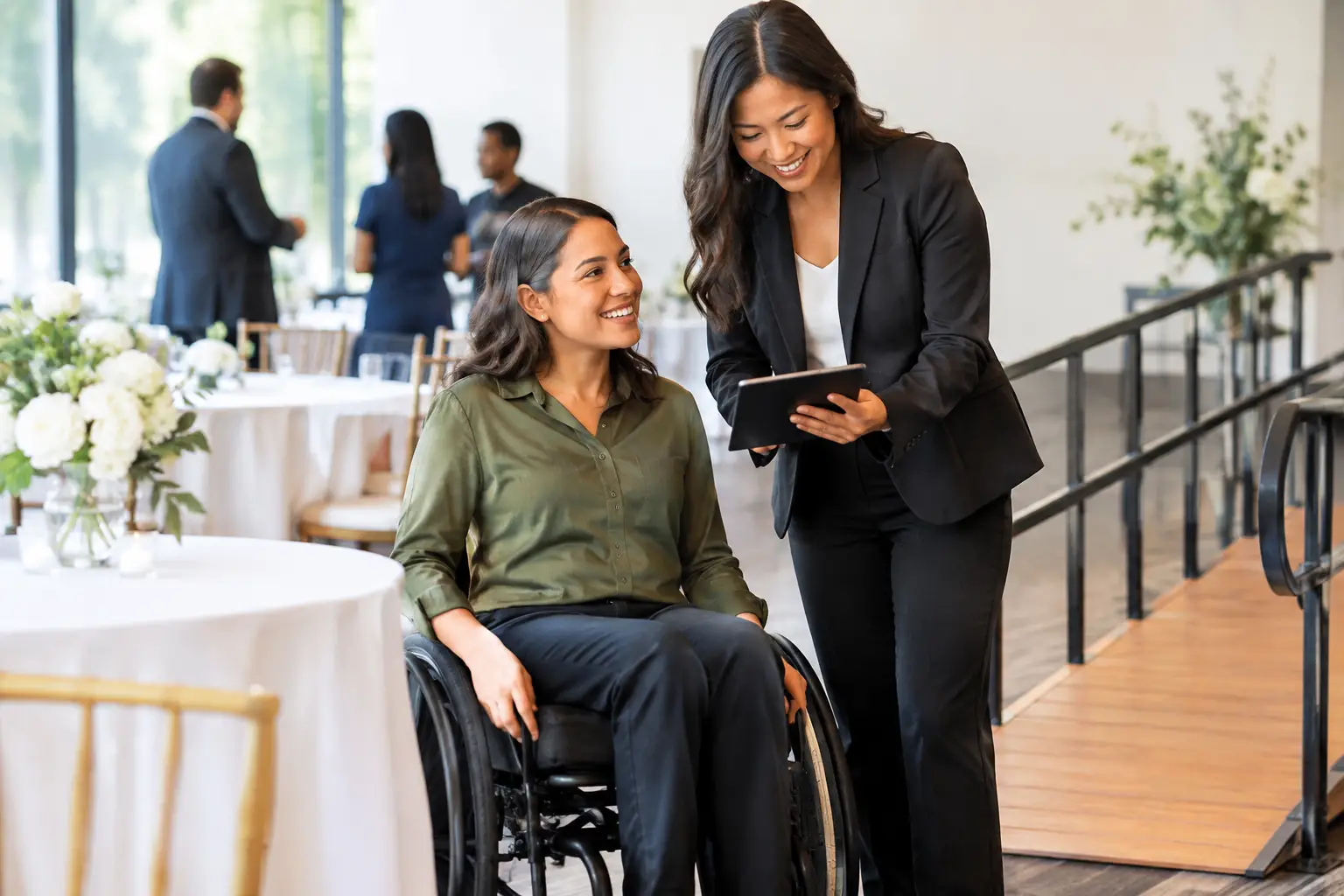
A packed room is not proof of a successful event. If attendees cannot enter the venue independently, follow the program, hear the speaker, read the presentation, participate in networking, or access the livestream, the room was never truly full. Accessible event planning services turn accessibility from a last-minute accommodation into a strategic advantage: better participation, stronger trust, and a brand experience that reflects who your organization says it serves.
For nonprofits, institutions, growing businesses, and public-facing organizations, that distinction carries real weight. Events are often where donors decide to deepen their support, customers decide whether they belong, and communities decide whether an organization understands them. Exclusion is not a minor operational miss. It can undercut the very relationship the event was meant to build.
Why accessible events are better events
Accessibility is sometimes treated as a compliance checklist – ramps, reserved seating, captions, done. Physical access and legal requirements matter, of course. But an event can meet a minimum standard and still leave people behind.
A better approach looks at the attendee journey from invitation to follow-up. Can someone using a screen reader register? Does the invitation clearly state what access supports are available? Can a Deaf attendee follow a panel discussion in real time? Is there a quieter space for an attendee who needs a break from an overstimulating reception? Can a virtual participant contribute, not just watch?
When planners address those questions early, they improve the experience for far more people than the audience members who disclose a disability. Captions help attendees in noisy spaces and people joining remotely. Clear wayfinding helps first-time visitors, older guests, and anyone rushing between sessions. Plain-language communications reduce confusion for busy executives and community members alike. Flexibility is not a niche feature. It is good audience strategy.
There is also a practical business case. Accessible experiences can broaden attendance, reduce last-minute scrambling, protect organizational reputation, and produce more useful engagement data. Most importantly, they demonstrate respect before an attendee ever reaches the registration desk.
Accessible event planning services start before the venue contract
The strongest accessibility decisions happen when there is still room to make meaningful choices. Once a venue is signed, an agenda is packed, and production is scoped, options narrow and costs can rise. That is why accessibility should be built into event strategy, budget, vendor selection, creative, and production planning from the beginning.
Begin with the audience, not assumptions
No two events require the same access plan. A fundraising gala, a government-adjacent summit, an employee town hall, and a hybrid education conference each create different barriers and different opportunities.
Start by identifying who needs to participate and how. Consider mobility access, sensory needs, hearing and vision access, language access, dietary requirements, caregiver needs, digital access, and the realities of travel or public transportation. Then provide a dignified way for attendees to request accommodations during registration. The request process should be straightforward, private, and actively monitored. A form that collects requests but receives no response is not accessibility.
It also depends on the event format. A small invitation-only dinner may need individualized support and a highly informed host team. A large conference may require a formal accessibility plan, dedicated access staff, live captioning, interpreters, accessible session rooms, and an escalation path when something changes on site.
Choose venues with the full experience in mind
A venue may advertise itself as accessible while presenting obstacles in practice. The accessible entrance could be poorly marked, the elevator may be far from the event floor, accessible restrooms may be inconveniently located, or the stage may only be reachable by stairs. These details affect whether guests can participate with dignity.
A proper site review should examine arrival and parking, drop-off zones, entrances, registration, room layouts, stages, restrooms, food service, emergency procedures, lighting, acoustics, and routes between programmed spaces. The question is not merely whether a person can get into the building. The question is whether they can move through the event independently and take part in the same moments as everyone else.
For outdoor activations, evaluate surface conditions, weather contingencies, accessible viewing areas, power for assistive technology, shade, seating, and transportation. A creative public event can be ambitious without making participation a test of endurance.
Design communications people can actually use
The audience experience begins with the first save-the-date. Registration pages, event emails, digital ads, presentation slides, signage, printed programs, and post-event materials all need attention.
Use readable type, thoughtful color contrast, descriptive headings, plain language, and clear instructions. Avoid putting essential information only in an image. Make sure video content includes captions and that digital documents are structured for assistive technology. For printed materials, consider large-print formats when appropriate and avoid design decisions that sacrifice clarity for visual trendiness.
Creative ambition and accessibility are not opposing forces. The best event brands make information easier to find, easier to understand, and harder to ignore. That is exactly what high-performing creative should do.
Technology can expand participation or create a new barrier
Hybrid and virtual events have made access more possible for many people, but technology alone does not guarantee inclusion. A livestream with poor audio, no captions, inaccessible slides, or no way for remote attendees to ask questions is a broadcast, not a shared experience.
Build the production plan around participation. That may mean live captioning, qualified sign language interpreters, accessible virtual platforms, microphones for audience questions, visual descriptions when needed, and a moderator assigned to bring remote questions into the conversation. Speakers should be briefed to use microphones, describe key visuals, avoid reading dense slides verbatim, and leave room for interpretation and captioning.
There are trade-offs. High-quality real-time accessibility services require budget and lead time, especially for complex programs or specialized content. But cutting them after registration opens often forces an organization into a more expensive and less effective response. The right investment depends on the audience, format, risk profile, and event goals. The wrong move is assuming no one needs support because no one has asked yet.
Build an operational plan, not a promise
Even a smart access strategy can fail at the point of delivery if the onsite team is unprepared. Every person touching the attendee experience should know what is available, where it is located, and who has authority to solve problems.
Brief registration staff, volunteers, venue teams, security, speakers, and production crews. Give them clear language and clear escalation paths. They do not need to become disability experts overnight, but they do need to avoid assumptions, listen carefully, and act quickly.
This is where a strategic event partner earns its place. Accessibility intersects with venue operations, creative, A/V, content, staffing, transportation, catering, and client communications. It cannot sit in a separate folder owned by one person. LARA Marketing Group approaches event execution as an integrated brand experience, bringing the planning discipline and onsite responsiveness needed to connect those moving parts.
A useful plan also includes contingencies. What happens if an interpreter is delayed, an elevator goes out of service, captions fail, a room changes, or a guest arrives with an unanticipated need? No team can predict every circumstance. Prepared teams can respond without making the attendee carry the burden of finding a solution.
Measure what participation looked like
Attendance counts tell only part of the story. To understand whether an event was accessible, ask whether attendees could engage fully. Track accommodation requests and fulfillment, access-related questions, virtual participation, session engagement, and feedback about navigation, communications, and support.
Post-event surveys should invite feedback without placing the responsibility on attendees to educate the organization. Ask direct questions about how easy it was to register, arrive, navigate, access content, and participate. Review the feedback with the same seriousness you would apply to sponsor results, lead volume, or donor conversion.
Not every improvement requires a major production budget. Sometimes the highest-impact change is earlier communication, better signage, a revised room layout, a more accessible registration platform, or a speaker briefing that makes the program easier to follow. Other moments demand larger investments. The goal is progress with accountability, not performative perfection.
The organizations that stand apart are not the ones that claim to welcome everyone. They are the ones that plan like everyone belongs in the room – and make that promise visible in every detail.
0 Comments